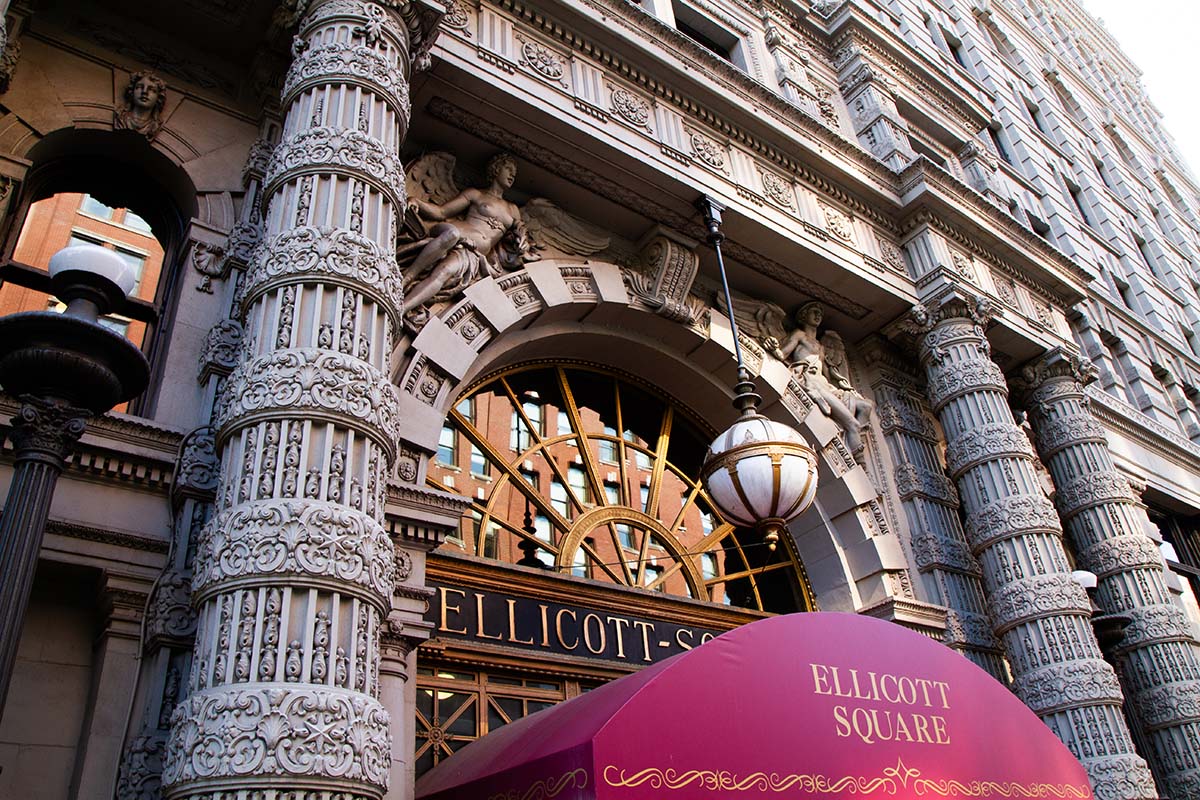
If you stand outside the Ellicott Square Building today, it is easy to miss just how visually loud it used to be. But 130 years ago, the Ellicott Square Building was not trying to be subtle in the slightest. It was designed to announce itself as one of the most ambitious commercial buildings in the country, and at the time of its completion in 1896 it absolutely succeeded.
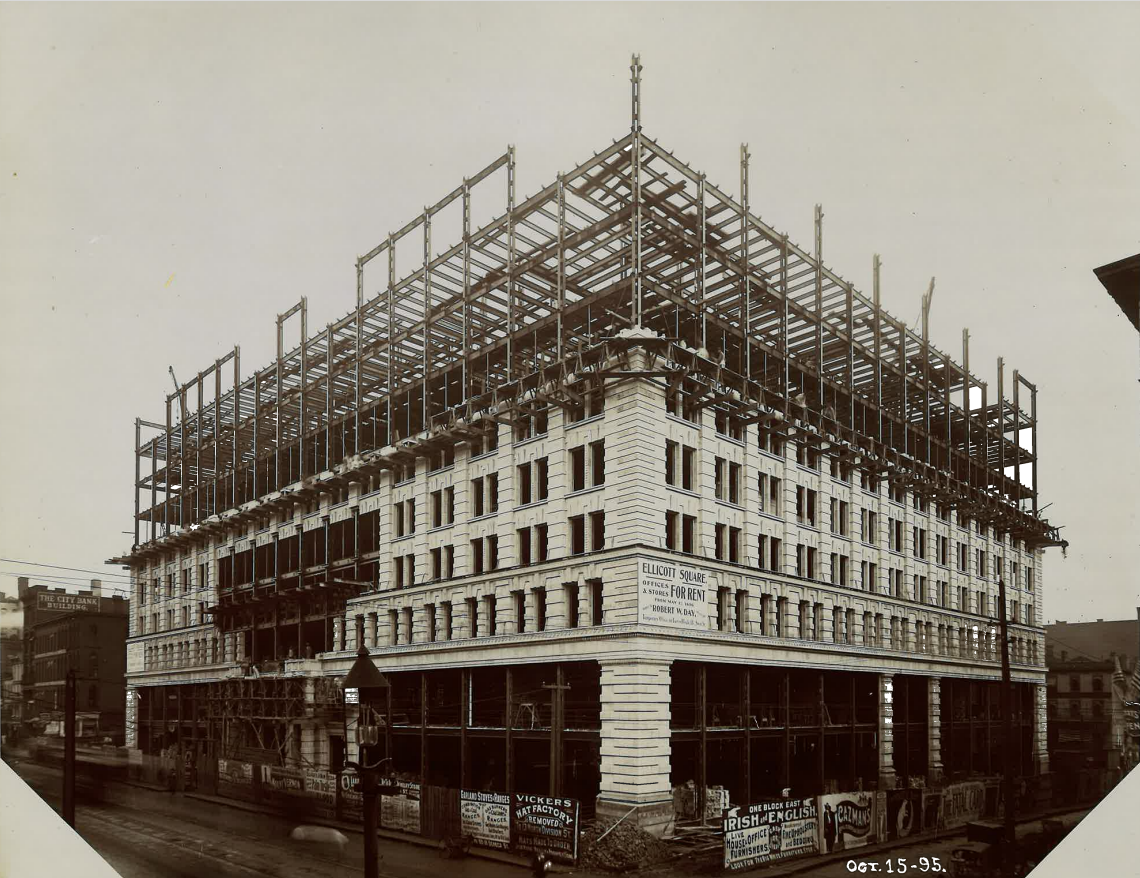
The building was constructed with a steel frame structure, which was still a relatively modern approach at the end of the 19th century. That steel skeleton allowed for its massive scale and wide-open interior court, but everything you saw and touched was a mix of carefully chosen materials meant to signal permanence and wealth. The exterior combined granite at the base with extensive terra cotta detailing and brickwork, originally layered with decorative ornament that gave the façade a much more elaborate and almost theatrical appearance than what remains today.
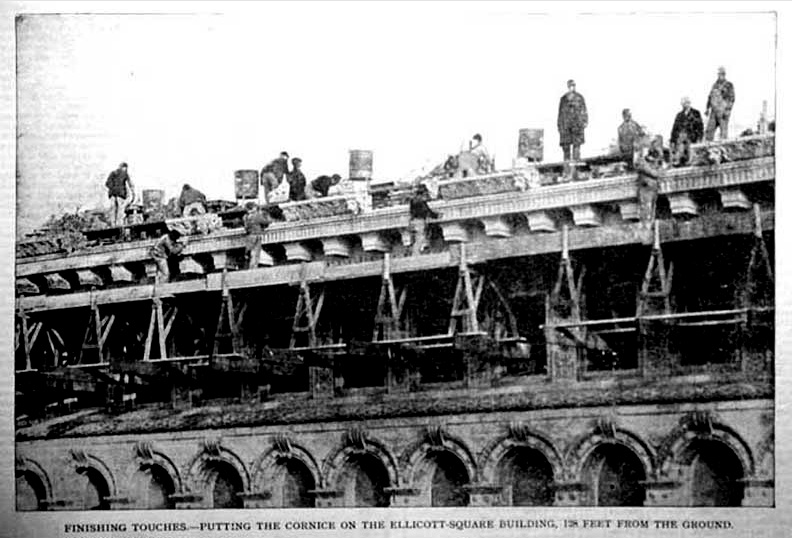
A lot of that exterior ornamentation did not survive. Around the 1970s, several decorative terra cotta elements were removed or simplified during restoration efforts, which was very typical for mid-century preservation logic that sometimes leaned more toward “clean it up” than “keep every detail intact.” So, while the building still feels impressive, it’s a slightly toned-down version of its original self, which is wild to think about when you are standing in front of it now.
Inside is where the building really shows off.
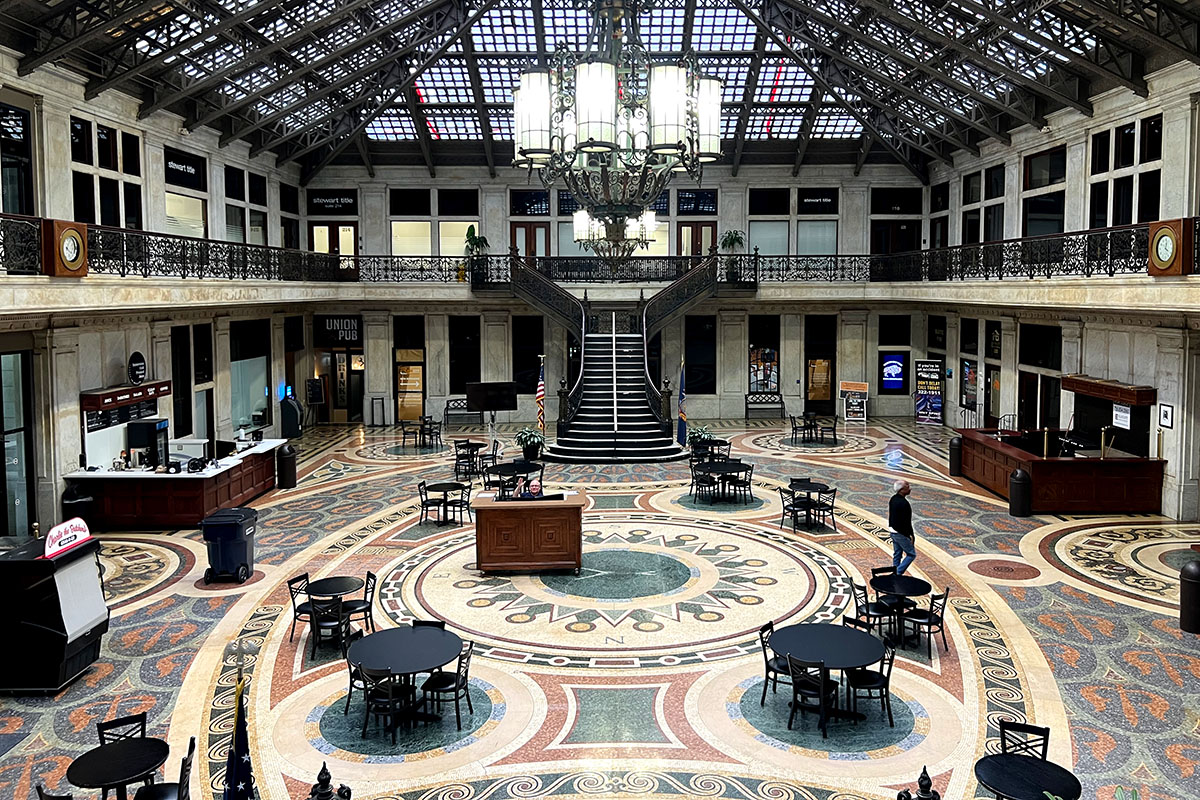
The most iconic feature is the interior atrium, which rises through the center of the building and is surrounded by multiple levels of offices looking inward. The floor of that central space is one of its most famous design elements, added during a 1930–31 renovation, the patterned mosaic tile surface that feels more like something you would expect in a historic European arcade than a commercial office building in Buffalo. It creates this almost unexpected moment of softness and artistry in what is otherwise a very business-driven environment.
The mosaic floor does not come without its controversies though. One of the main details people see on the floor are geometric symbols that were historically associated with prosperity and good fortune prior to World War II. While their meaning has since evolved, the original design remains part of the building’s historical fabric and reflects design conventions of the time. During the early period of World War II, the German consulate was located within the Ellicott Square Building, and they tried to demand that the symbols be removed from the floor. If you look at the floor today, you can tell that their demands were not met. The consulate inevitably left and decided to find another facility to suit their needs.
Materials throughout the interior lean heavily into marble, decorative tile, carved wood accents, and ironwork details that reflect the building’s Gilded Age origins. Even the staircases and railings were designed with a level of craftsmanship that makes modern office buildings feel a little less detailed in comparison.
But the Ellicott Square Building was never just about aesthetics. It was designed to function like a vertical city, and that meant packing in an entire ecosystem of tenants that reflected Buffalo’s economic identity at the time.
Law firms were everywhere, especially ones tied to shipping, railroads, and insurance. Grain and trade companies had offices here as Buffalo’s position as a major port city on the Great Lakes made it a hub for agricultural commerce. Financial institutions and banking firms also filled substantial portions of the building, reinforcing its role as a sort of business headquarters for the region.
There were also educational and professional training spaces inside, including business schools and commercial programs like those associated with Buffalo’s early business colleges, which trained students in bookkeeping, shorthand, and office administration. It was very much the kind of place where you could literally go from studying how to run a business to working in one without ever leaving the building.
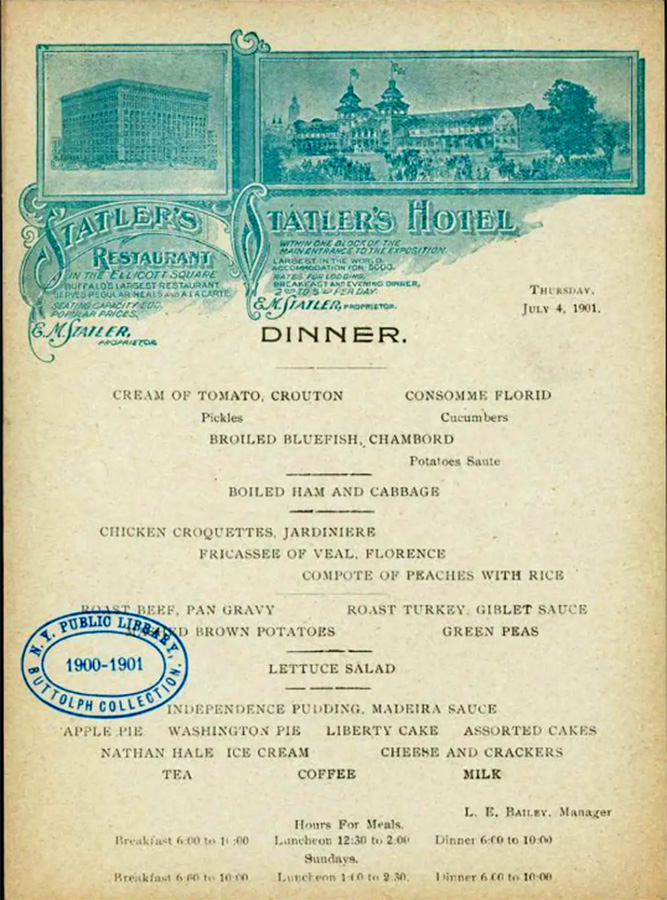
And then there was the social and hospitality layer, which is where things get especially interesting. Over time, parts of the building and its immediate tenant network included restaurants and cafés that served the constant flow of workers and visitors. Among the names that appear in historical references is Statler’s restaurant, which reflects how closely tied the building was to Buffalo’s broader downtown hospitality scene, especially during the early 20th century when nearby hotels and dining rooms shaped much of the city’s business culture.
One of the most fascinating historical footnotes is how adaptable interior spaces were. The building famously housed early entertainment and assembly spaces like Vitascope Hall in its early years, showing how quickly commercial architecture in that era could shift between business, education, and culture depending on demand.
What makes the Ellicott Square Building so visually and historically interesting is that it never fully committed to just one identity. It was part office building, part commercial arcade, part educational hub, part social club, and part cultural experiment all at once. Every material choice, from the steel frame hidden beneath it all to the mosaic tile underfoot, was part of that ambition to create a complete environment instead of just a structure.
Even now, after decades of change and some loss of original exterior detail, it still carries that layered feeling. There are characteristics from all eras within the building telling us the story of Buffalo. Even something as small as the elevator doors were designed with purpose; the top four panels representing Buffalo pre-industrialization, and the bottom four panels representing post-industrialized Buffalo. You cannot just look at it as a building. You need to read it like a record of what Buffalo used to be when it believed it was building the future in real time.